
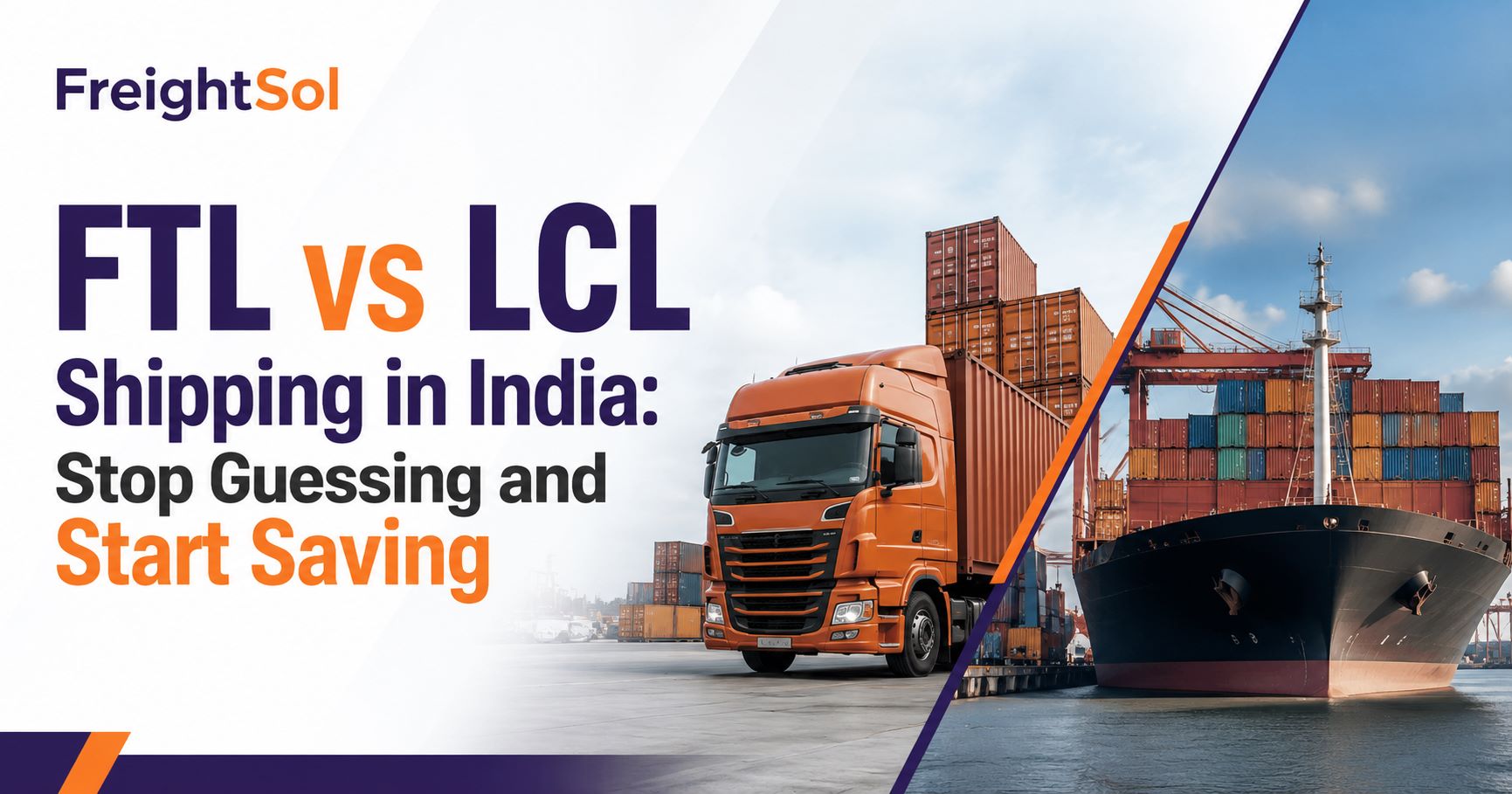
One wrong freight decision can cost your business thousands — and delay your deliveries too. FTL or LCL? It sounds like a simple choice, but it directly impacts your margins, your timelines, and your supply chain efficiency.
In this guide, we break down FTL vs LCL shipping in India — what each means, when to use which, and how businesses in Ahmedabad can make smarter, more cost-effective freight decisions.
Full Truck Load (FTL) means that a Company books a complete Truck Load for its Shipment. The Truck is dedicated to a single Shipment only, with the Truck typically going directly from the original point of origin to the Delivery Point without making separate stops at other Locations.
In Full Truck Load vs Less than Container Load, FTL is ideal when cargo volume is high or deliveries are time-sensitive.a
Faster transit time
The Truck is completely dedicated to moving only that Single Shipment. Therefore, the overall Transit Time is usually reduced because there are less Loading and Unloading Locations than if the Truck was making multiple stops at other Locations.
Lower handling risk
Unlike moving Less than Container Load, the Cargo remains in one Truck from Point of Origin to the Delivery Point; therefore, the likelihood of Damage to the Goods is much lower than if you were shipping either LCL or an Intermodal Truck and Rail Combination Shipment.
Better delivery control
Businesses get more predictable delivery schedules and improved shipment visibility.
Higher supply chain efficiency
Manufacturers and exporters can optimize production-to-delivery workflows.
For Ahmedabad industries dealing with large cargo movement, FTL often supports better freight forwarding efficiency and faster operations.
LCL (Less than Container Load) is a shipping solution where multiple shippers use the same freight space for their goods. Rather than having to ship an entire container, shippers can share freight space and only pay for the volume that they actually use.
In comparison to FTL (Full Truck Load), LCL is best suited for shippers looking to ship smaller shipments without needing to fill a full vehicle container.
Lower initial freight cost
Businesses only pay for occupied cargo space.
Suitable for SMEs and D2C brands
Smaller inventory movements become financially manageable.
Flexible shipment planning
Companies can move goods without waiting to fill a full truck.
LCL suits:
Most often, for a growing business, using LCL for shipping will be one of the most affordable options.
|
Factor |
FTL Shipping |
LCL Shipping |
|
Cost |
Higher upfront cost |
Lower cost for smaller shipments |
|
Transit Time |
Faster |
Comparatively slower |
|
Shipment Volume |
Large cargo loads |
Small to medium cargo |
|
Flexibility |
Less flexible for small shipments |
High flexibility |
|
Risk |
Lower handling risk |
Slightly higher handling exposure |
|
Business Suitability |
Manufacturers, exporters, bulk movement |
SMEs, D2C, wholesalers |
The decision between Full Truck Load vs Less than Container Load depends mainly on cargo volume, urgency, and transport priorities.
Ahmedabad is one of the largest manufacturing centers in India and many industries rely on large logistics networks to transport goods from factories to retail and other locations. Textile, Chemical, Pharmaceutical, Engineering, Ceramic and Export businesses will use freight options based on their specific operations.
For these sectors, selecting the best freight option for businesses in Ahmedabad depends on operational needs.
Textile manufacturers often dispatch high-volume cargo. FTL becomes more practical due to direct movement and lower transit delays.
Chemical shipments usually require dedicated transport and handling compliance, making FTL preferable.
Pharmaceutical cargo frequently involves strict delivery timelines and safety requirements. FTL supports controlled movement.
Growing businesses shipping smaller inventory batches often gain better cost efficiency using LCL.
Export trade companies frequently use both FTL and LCL depending on how much product they are shipping and the timing of shipments.
Generally, flexible logistics strategy will generally improve efficiencies in a company’s supply chain, and balance the freight costs associated with shipping.
The determination of which freight model to use is not the determination of which option is better or worse. It is based on a business’s specific situation.
Example: An Ahmedabad engineering company dispatching machinery to another state may benefit from FTL.
Example: A direct-to-consumer (D2C) brand using smaller shipments of only limited inventory shipments could potentially lower its logistics costs by utilizing LCL.
Using both methods provides better shipment planning and transport cost optimization.
Freightsol provides businesses with real-world freight forwarding and logistics solutions based on their specific cargo requirements.
Instead of using one fixed model, Freightsol evaluates:
These factors assist manufacturers, exporters, small-to-medium-sized businesses (SMEs), wholesalers, and D2C brands in moving goods more efficiently without sacrificing operational efficiency.
By selecting the right model(s) and improving logistics planning, businesses can reduce the number of unnecessary expenses and consequently build stronger supply chains.
What is the difference between FTL and LCL shipping?
FTL uses an entire truck for one shipment, while LCL shares transport space among multiple shipments. FTL offers faster transit, whereas LCL reduces costs for smaller cargo volumes.
Which shipping method is cheaper for small businesses?
SMEs/small business owners usually find LCL to be their least expensive shipping option because they will only pay for the space they use for their cargo.
Is FTL better for Ahmedabad manufacturers?
Yes, manufacturers in Ahmedabad dealing with bulk cargo, textiles, chemicals, or engineering products often benefit from FTL due to faster delivery and reduced handling.
Which freight option offers faster delivery?
Usually, FTL has the shortest shipping time because freight is delivered immediately without multiple points of loading and unloading.
How can businesses reduce logistics costs?
Businesses can reduce logistics costs by optimizing cargo volume, improving shipment planning, selecting suitable freight models, and partnering with experienced logistics providers.
Understanding FTL vs LCL Shipping in India is essential for businesses aiming to reduce transport expenses and improve delivery performance. The right freight model affects cargo movement, freight forwarding efficiency, shipment planning, and overall supply chain success.
When making their decision on whether to choose FTL or LCL as methods of shipping products internationally, manufacturers in the Ahmedabad area need to consider three significant components: how large their shipments are (in cubic volume); how quickly they need their shipments delivered; and what their operational objectives are.
Freightsol takes the guess work out of how to find intelligent logistics strategies to help manufacturers move their goods efficiently while simultaneously reducing their transportation expenses to accelerate their growth.

Please fill out the form below and we will get back to you as soon as possible.